
- Quản trị viên
- April 21, 2026
- Market Insights & Overview
Reduce Staffing Costs in Restaurants? An Effective Approach with Automated Ordering Systems
Labor costs are one of the biggest pressures for any restaurant or food business. As operations scale, the challenge becomes more apparent: increasing staff improves service quality but significantly raises costs, while cutting staff can negatively impact customer experience.
In this context, many restaurant owners are seeking a more sustainable solution – not by reducing headcount, but by reducing dependency on manual labor in operational processes. This is why automated ordering systems are becoming an increasingly popular choice in the F&B industry.
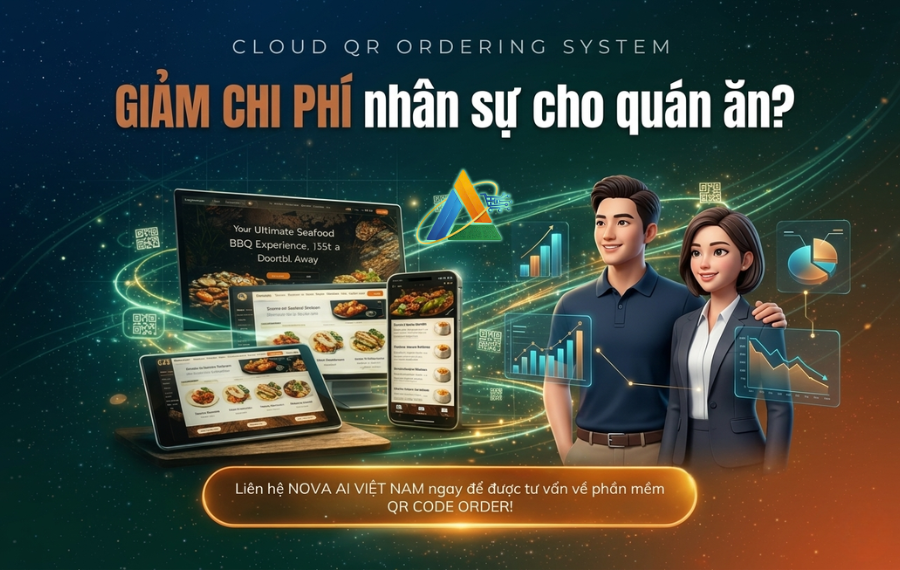
Rather than being just a support tool, an automated ordering system is evolving into a platform that enables restaurants to operate more efficiently, maintain better control, and optimize staffing costs in the long term.
1. Why Are Staffing Costs Difficult to Optimize in F&B?
In traditional models, most operational processes rely heavily on staff. From taking orders and communicating with the kitchen to assisting customers and handling payments, every step requires human involvement.
As a result, staffing costs go beyond salaries – they also include training, management, errors, and staff turnover.
Another common issue is inconsistent performance among staff. During peak hours, even a small delay can disrupt the entire workflow. To mitigate risks, many restaurants increase staffing levels, which further drives up operational costs.
This is also why many businesses adopt F&B software to support management. However, not all systems fully solve the problem.
2. The Traditional Approach: Cutting Staff Comes with Risks
Some restaurants attempt to reduce costs by cutting staff. While this may offer short-term savings, it often introduces long-term risks.
With fewer employees, each staff member must handle more tasks, leading to:
- Increased order errors
- Slower service
- Declining customer experience
Over time, these issues directly impact revenue and customer retention.
The core problem is not the number of staff, but the heavy reliance on manual processes. Without changing the operational model, reducing staff will always come with trade-offs.
3. A New Approach: Optimizing Processes with Automated Ordering Systems
Modern restaurants are shifting toward a different strategy. Instead of reducing staff, they use automated ordering systems to minimize repetitive tasks.
When customers can browse menus, place orders, and make payments independently, many steps in the service process are streamlined. Staff no longer need to handle repetitive manual tasks, reducing pressure and improving efficiency.
An effective automated ordering system not only saves time but also stabilizes operations – allowing restaurants to control labor costs without compromising service quality.
4. How Automated Ordering Systems Solve Staffing Challenges
Implementing an automated ordering system significantly reduces workload in key operational areas.
First, self-ordering eliminates manual order-taking, reducing service time and minimizing errors. Orders are sent directly to the kitchen, making the process faster and more accurate.
Second, integrated payments reduce the need for staff to handle individual transactions—especially valuable during peak hours.
Most importantly, automated systems standardize operations. When processes are system-driven, restaurants no longer depend heavily on individual staff performance.
5. Optimizing Staffing While Enhancing Customer Experience
A common concern is that reducing reliance on staff may make the experience feel less “human.” However, when implemented correctly, the opposite is often true.
By automating basic tasks, staff gain more time to focus on high-value interactions – such as recommending dishes, assisting customers, and handling special requests.
This leads to improved service quality rather than a decline.
6. The Role of Automated Ordering Systems in Cost Control
Beyond workload reduction, automated ordering systems also improve cost control.
With all orders and payments recorded digitally, restaurant owners can:
- Track revenue in real time
- Reconcile transactions
- Reduce discrepancies and increase transparency
Additionally, system data provides valuable insights into customer behavior. This enables restaurants to:
- Optimize menus
- Adjust pricing strategies
- Develop more effective business strategies
👉 These insights are key to long-term profitability.
7. When Should You Implement an Automated Ordering System?
Restaurants should consider adopting an automated ordering system when they begin to experience:
- Overworked staff
- Long customer wait times
- Rising labor costs without improved performance
These are clear signals that operational changes can deliver meaningful improvements – not only in cost efficiency but also in customer experience.
Reducing staffing costs is not about cutting people – it’s about optimizing how your restaurant operates. When repetitive tasks are automated and processes are standardized, businesses can achieve greater efficiency with the same resources.
In this context, an automated ordering system is not just a tool – it’s a strategic solution that enables smarter operations, better control, and sustainable growth in the F&B industry.
🚀 Get Started with NOVA AI Vietnam
Contact us today to find the right automated ordering system for your restaurant:
- Real-world demo tailored to your model
- In-depth staffing and operational analysis
- Cost-optimized, performance-driven solutions
[Connect with us to elevate and redefine your brand experience]
👉 Optimizing staffing isn’t about reducing – it’s about operating smarter.