
- Quản trị viên
- April 23, 2026
- Strategic Recommendations for Restaurants
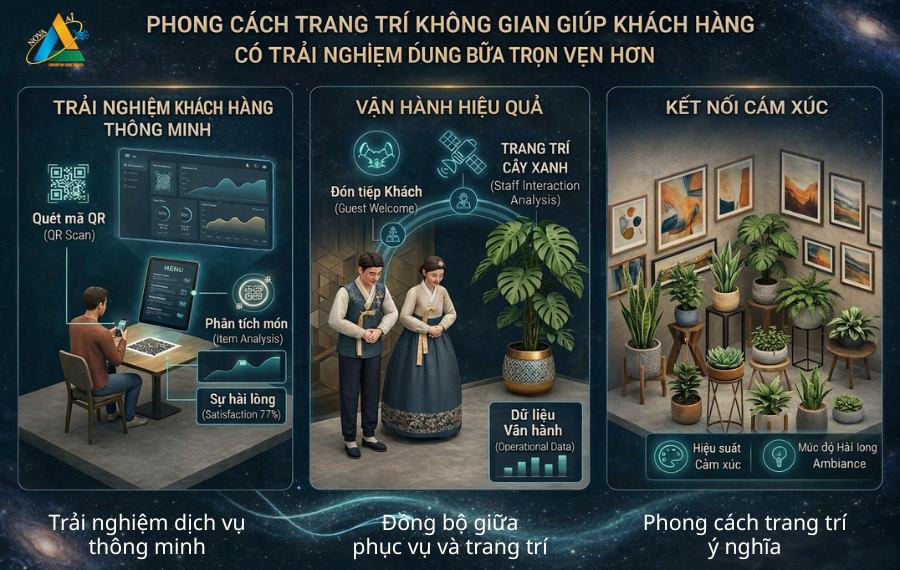
Dining Space Design Styles That Enhance the Customer Dining Experience
Many restaurants invest heavily in design but overlook one critical question: when customers walk in, do they understand what the space represents? When a space is only “beautiful,” it may impress at first glance but fails to create a deeper connection. The issue is that the design does not communicate a clear message, forcing customers to interpret it themselves. This directly impacts the customer dining experience, even if they don’t consciously realize why.
To solve this, the space should be built as a visual communication system. Every detail – from color and materials to layout – must answer one question: what does this restaurant stand for? When customers immediately “get it,” they not only feel more comfortable but also connect more naturally with the intended experience.
1. An unclear concept leads to a “misaligned” experience
A common mistake is choosing a trendy concept without fully executing it. A restaurant may include a few Korean or Japanese-inspired elements, but the overall space lacks consistency. Customers may feel it’s “somewhat right,” but not convincing.
The problem lies in misunderstanding what a concept is. A concept is not just a decorative style – it’s a guiding direction. Without consistency, the space becomes fragmented, reducing the quality of the customer dining experience.
Restaurant owners should translate the concept into clear, recognizable elements. For example, with a Korean concept, it should go beyond visuals and align across:
- Visuals: hanbok imagery, Korean signage, cultural details
- Interior: furniture style and layout reflecting Korean dining culture
- Sound and behavior: suitable music, simple greeting style
When these elements align, customers can immediately feel the concept without thinking.
2. A space without storytelling weakens brand identity
Many restaurants have unique stories, yet customers remain unaware. When the space communicates nothing, the experience becomes purely transactional – just eating, without memorability.
This happens because design and branding are disconnected. The story exists but isn’t expressed in the space, making the customer dining experience feel shallow, even if the product is good.
Restaurants should use space as a storytelling medium:
- Timeline visuals
- Key milestones
- Certifications and awards
- A short, easy-to-read brand story
When customers can “see” the journey while dining, they remember it longer and are more likely to return.
3. Beautiful design that doesn’t support real behavior
Some restaurants look great but create friction in actual use: difficult navigation, unclear ordering process, or long wait times. Individually small, these issues accumulate and significantly reduce the customer dining experience.
The root cause is the disconnect between design and operations. Spaces are designed first, then operations are forced into them.
Instead, design should follow the real customer journey: entering, seating, viewing the menu, ordering, dining, and paying. Each step must be supported by the space. Only then does the space become not just beautiful, but usable.
4. Menu not integrated into the space disrupts the experience
Menus are often treated as separate elements, but they are critical touchpoints. When customers must wait for a menu or struggle to read it, the experience is interrupted.
This happens because menus are designed for presentation, not behavior. It reduces customer autonomy and impacts the customer dining experience.
Menus should be integrated into the space in the most accessible way. Customers should be able to view them instantly when ready, without relying entirely on staff. When ordering becomes effortless, the entire experience improves.
5. Lack of consistency reduces overall perception
A restaurant with multiple “beautiful corners” but inconsistent styles across areas creates a fragmented impression. Even if each part works individually, the whole fails to stand out.
This results from lacking a unified design standard. Continuous additions without overall control weaken cohesion, negatively affecting the customer dining experience.
The solution is to define a core style and ensure all details align with it. Not more elements – just the right ones, consistently applied.
6. Lack of autonomy slows down the experience
When customers depend entirely on staff for ordering, checking orders, or payment, the experience slows down – especially during peak hours.
This is not just a staffing issue but a structural one. The space and process are not optimized for customer autonomy, directly affecting the customer dining experience.
The solution is to reduce unnecessary steps. The space should enable customers to perform simple actions easily. When customers feel in control, the experience becomes faster and clearer.
7. Lighting, sound, and emotion: invisible but powerful factors
Lighting and sound are subtle but highly influential. Too bright, too dim, or mismatched music can negatively impact emotions.
These elements are often set based on intuition and rarely adjusted by time or audience. The result is discomfort, shorter stays, and a weaker customer dining experience, even if the space looks good.
The solution is dynamic adjustment based on time and customer type rather than fixed settings.
8. A seamless experience eliminates “thinking points”
A great experience is not about standout moments, but about removing friction. When customers have to ask, “Where do I order?” or “How do I pay?”, the space has failed its role.
This happens when touchpoints are disconnected. Each part may work individually but fails to form a smooth journey, disrupting the customer dining experience.
The solution is to design the entire journey as a continuous flow, eliminating moments that force customers to think.
9. True completeness comes from combining space and technology
A well-designed space helps customers feel comfortable, but if ordering and payment still require multiple steps, the experience remains incomplete.
Many restaurants optimize only the visible aspects, neglecting interaction. This extends the customer dining experience unnecessarily.
The solution is to create an environment where customers can easily access information and take action. When customers can view menus, place orders, and check details seamlessly, they feel more in control. Restaurants that effectively combine space design with modern ordering systems reduce wait times and errors, especially during peak hours.
A great space makes customers want to return – without knowing why
Customers don’t remember every detail, but they remember how the space made them feel. A good design doesn’t just look good – it helps customers understand, feel comfortable, and interact effortlessly throughout their journey.
The key is not investing more, but doing it right. When space is designed based on behavior, everything becomes natural, and the customer dining experience improves significantly.
Instead of redesigning everything, start by reviewing the actual customer journey. Experience it as a first-time visitor: do you immediately understand how it works? Do you have to wait? Are there moments that require asking?
These details reveal what needs improvement.
Then prioritize simple changes with high impact: clearer guidance, better layout, and more intuitive menu design. Once the basics are clear, reduce reliance on staff for repetitive tasks.
When space and interaction are optimized together, you’ll see a clear shift: customers stay longer and return more often – not because the restaurant looks better, but because the experience is truly complete.